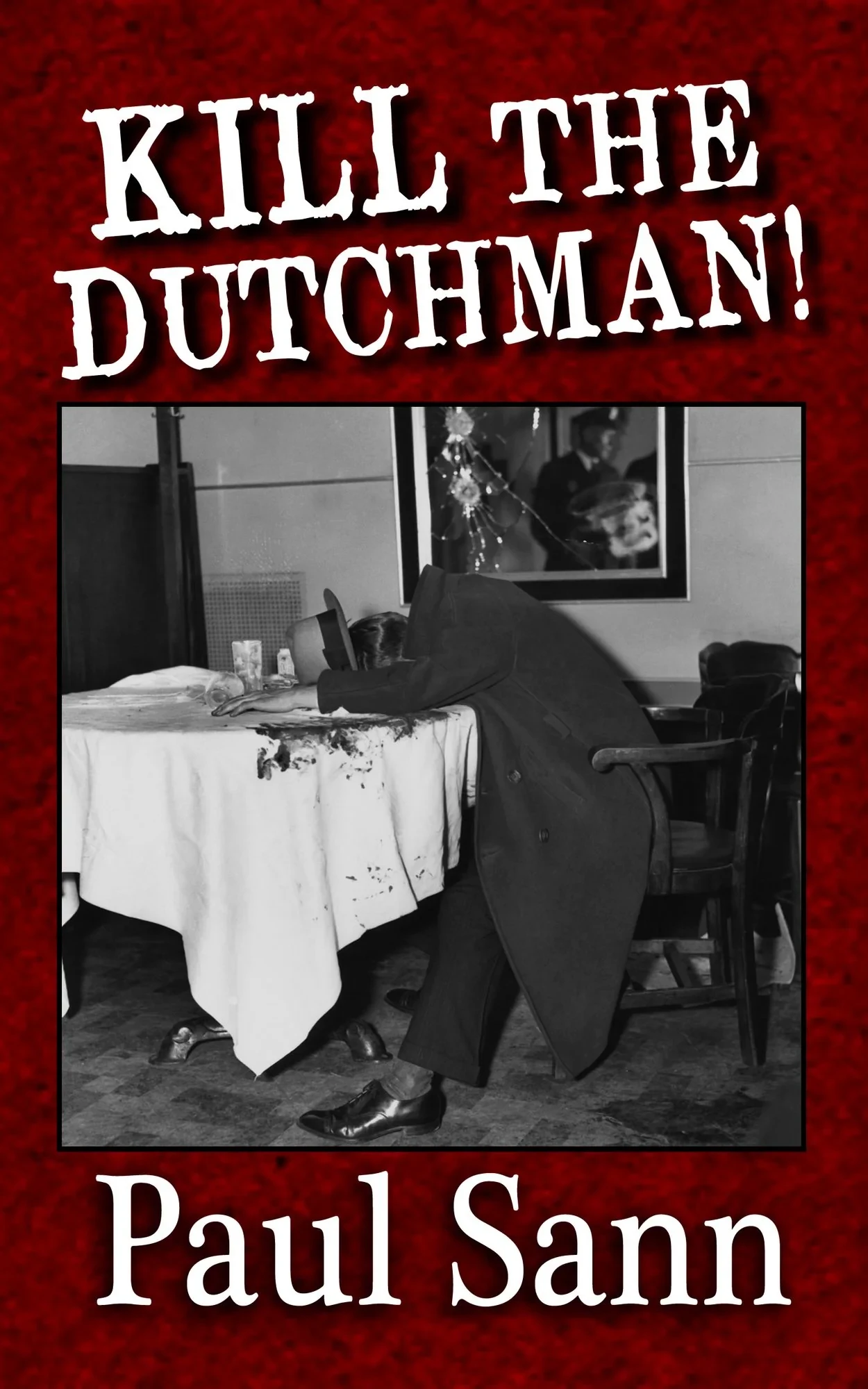
KILL THE DUTCHMAN!
by Paul Sann
Kill the Dutchman!
Introduction
When I first read this book, I was thirty years old and had just signed a contract to write a book of my own. The year was 1988. The book that I was about to write would be my first, a challenge for any would-be author. I would need all the inspiration I could get, which is why I turned to Kill the Dutchman! By 1988, the book was already renowned among writers and readers with an interest in the subject of gangsters and organized crime. For me, Paul Sann's masterpiece was a revelation, in more ways than one.
The book I was working on was an account of a violent, loosely connected gang of hooligans from the West Side of Manhattan known as The Westies. Their criminal antics were so reprehensible that I was having a hard time figuring out how to approach the subject, how to find the right tone. This is a problem encountered by any journalist or author when writing about gangsters. Should the tone be one of moral outrage, given that gangsters and their enablers are engaged in an aspect of American commerce that involves violent intimidation, thuggery and murder. Or does a writer go in the opposite direction, choosing to lampoon the unseemly aspects of organized crime and gangsterism through satire and irreverence, as the great newspaper columnist Jimmy Breslin had done in his journalism and in his famous novel, The Gang that Couldn't Shoot Straight.
Reading Kill the Dutchman!, I realized that Paul Sann had done something else entirely. Sann brought such an expansive body of knowledge to his subject—not just of organized crime but of the vicissitudes of human nature—that he went beyond moralisms or the distancing device of satire to achieve something deeper: a wry, bracing and sometimes humorous tone that acknowledged the fallen nature of the species. In Kill the Dutchman!, Paul Sann wasn't just writing about gangsters and the particular universe of organized crime. He was writing about the human condition.
When Sann published this book in 1971, he was already a legendary New York City newspaper reporter and editor. The book may have been his attempt to transcend time and recapture the New York of his youth, when gangsters such as Dutch Schultz were quasi-romantic figures bringing illegal booze and other seemingly benign vices to the masses. But the book is also an attempt to encapsulate the mores and attitudes of New York City, America's greatest and most dramatic urban metropolis.
Kill the Dutchman! is so knowing and sardonic in its depiction of big city life in the early decades of the Twentieth Century that it should be required reading alongside the much more exalted tomes of social history, such as Robert Caro's non-fiction masterpiece The Power Broker, which, despite its monastic accumulation of information and insight, does not contain one-tenth the street smarts and knowing wit of Sann's dissection of the alliance between politics, business and murder that is the basis of organized crime in America. The density of the reporting is like a rich sauce, with flavors and complexities from another time and place.
Reading the first two chapters of Kill the Dutchman!, in which Sann describes Schultz's infamous demise at the hands of multiple assassins at the Palace Chop House and Tavern on East Park Street in Newark, N.J., is akin to standing in front of a painting by Winslow Homer at the Metropolitan Museum of Art. Behold the canvas! The longer you look, the more details you will comprehend, until you realize that you are in the hands of a master.
The book is filled with treasures, each chapter a meditation on some fresh angle, the totality of which is an unparalleled portrait of one of the most unorthodox gangsters in the history of the American underworld. As a German Jew, Schultz did not have at his beck and call a gang, as might a like-minded Irish or Italian Mob boss. He was both a partner and at times at odds with the New York combine, which sought to control all rackets along the Eastern seaboard with corporate efficiency. One of the great wonders of Kill the Dutchman! is that it illuminates Schultz's rise while at the same time never losing sight of the larger canvas—the big picture—making this one of the essential reads on the larger subject of the Prohibition era and its criminal legacy.
For many, the coup d'grace of this book will be the author's detailed attempt to make sense of the Dutchman's dying words. Riddled with bullets, lying on his deathbed in a Newark hospital, Schultz delivered a feverish monologue that was written down by the police chief's male secretary. In his re-telling of the incident, Sann, of course, provides every minute detail, from the size of the cramped hospital room (10 by 15 feet) to the dying patient's body temperature (106 degrees). He reprints in its entirety the Dutchman's dying statement, then spends an entire chapter parsing the words in search of hidden meaning.
Schultz's "ravings," as they were portrayed in the press at the time, are filled with many dazzling alliterations, some incomprehensible ("a boy has never wept/nor dashed a thousand kim"), some explicit ("Journey's end. This is my death."), and some tinged with the regret of a doomed sinner ("Mother is the best bet and don't let Satan draw you too fast."). Sann's efforts to untangle what he calls "the last soliloquy" of a gangster who harbored many secrets is Homeric in its intensity and carries with it the weight of a master anthropologist studying the ancient text of a dying pharaoh.
Time has not diminished Kill the Dutchman!, and it is a great pleasure to those of us who cherish this book to see it find new life in paperback and electronic form. To me, the book will always hold a special place in my imagination as having provided the spark that made it possible for me to write about the gangster life without ever losing my sanity. Sann brought humanity and profound literary skills to bear on a difficult subject, elevating the art of crime writing to new levels. Now, a new generation of readers can benefit from Paul Sann's labors, and also, perhaps, be enthralled by the timeless quality of something that will always have value, no matter the technology: a great story rendered with elegance and authenticity by a master of the craft.
T.J. English
New York City, September 25, 2014